
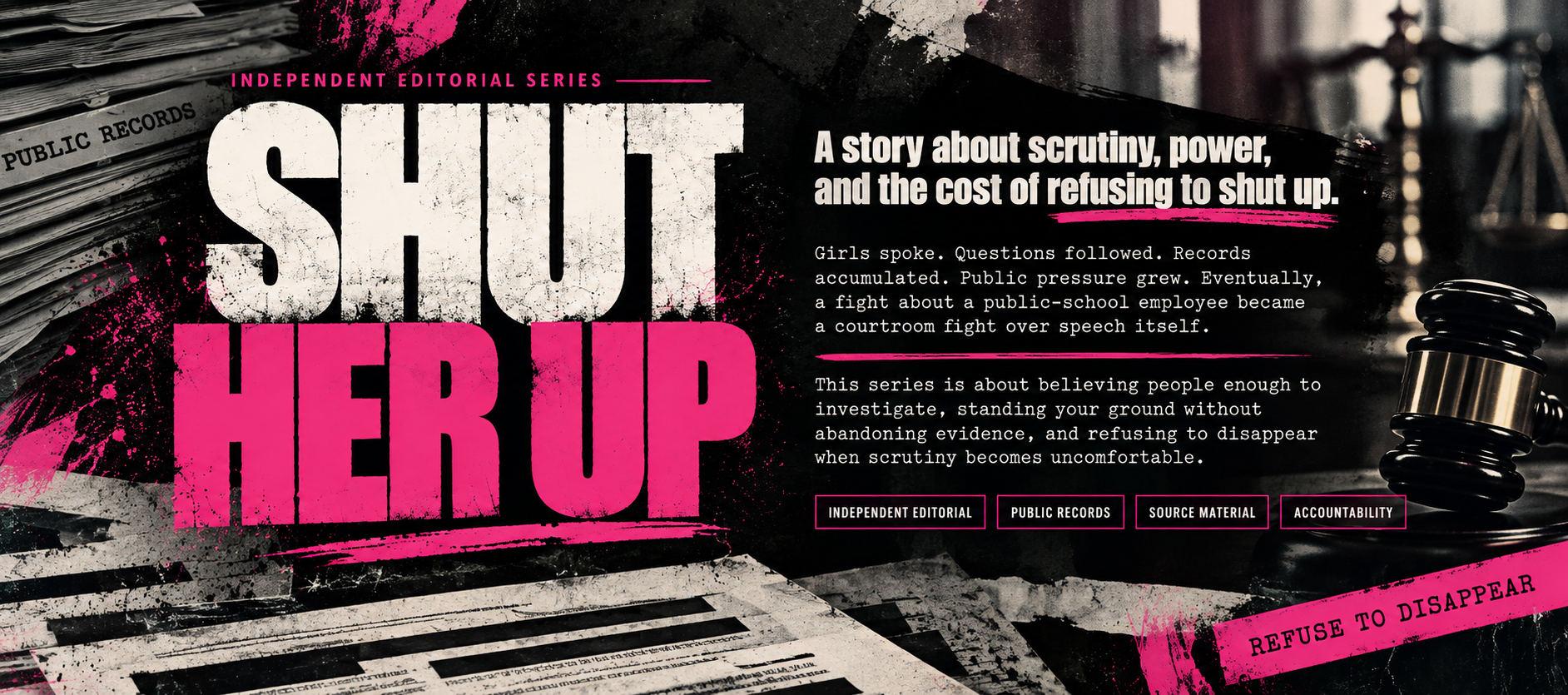
Series Introduction
SHUT HER UP
Scrutiny, power, girls who spoke up, public-school accountability, and the cost of refusing to disappear.
There are stories that begin with a scandal. There are stories that begin with a lawsuit. This one began with people talking.
Girls and young women talked about experiences that made them uncomfortable. Former students talked. Parents talked. People who had crossed paths with Dustin Roland over the years began comparing what they remembered, what they had heard, what they had reported, and what they believed adults in positions of authority should have taken more seriously. Some of those accounts became complaints. Some became records. Some remained personal accounts that could not independently establish what happened. But taken together, they raised questions that deserved something more than dismissal.
That is where this story really begins.
Over time, the questions surrounding Roland became questions about something larger: what Des Moines Public Schools knew, what had been reported, how those reports were handled, what investigators concluded, what they did not conclude, and why the controversy kept resurfacing. A public-school employee was being discussed publicly because his conduct and the institution’s response to it had become matters of public concern. The record eventually included complaints, district documents, public accounts, and a recording of Roland himself addressing middle-school students about allegations involving him.
That recording matters because it strips away some of the distance that usually surrounds stories like this. It is not somebody describing what Roland supposedly said. It is Roland speaking for himself, in a classroom, to children. Viewers can hear the words, watch the delivery, consider the setting, and reach their own conclusions about whether that conversation belonged in a middle-school classroom at all. It raises questions not only about Roland’s judgment, but about institutional judgment: who knew, who approved, who reviewed it afterward, and what standards were being applied when an adult employee chose to discuss allegations about himself with students.
Those are fair questions.
They are also uncomfortable questions.
And uncomfortable questions have a way of changing the subject.
Eventually the conversation stopped being only about the complaints, the records, Roland, and the district. It increasingly became about Kathryn Inacardigan—the woman who would not stop talking about them. She posted. She argued. She criticized. She organized. She pushed people to look at the record. She was not quiet, polished, deferential, or particularly interested in making powerful people comfortable. Sometimes her language was angry. Sometimes it was abrasive. She made enemies. None of that is especially mysterious.
But anger does not make the underlying questions disappear.
Neither does profanity.
Neither does disliking the person asking them.
And there is something deeply familiar about what happens next in stories involving power. The person raising the problem slowly becomes the problem. Scrutiny of conduct becomes scrutiny of the critic. The argument shifts from What happened? to Why won’t she stop? The discomfort created by the underlying facts becomes easier to manage if attention can be redirected toward the person demanding answers.
Then the dispute reached court.
On September 29, 2026, an Iowa judge entered an immediate ex parte temporary injunction against Kathryn Inacardigan in litigation brought by Dustin Roland. Among its provisions, the order restricted Kathryn from disseminating or posting information concerning Roland and directed removal of references to him that she had placed publicly or online. The order was issued before the ordinary adversarial process had fully played out, and Kathryn has grounds available to ask the court to dissolve, vacate, or narrow it.
The order exists. It must be respected while it exists. Standing your ground does not mean pretending a court order is optional. It means preserving evidence, complying with what the court has ordered, challenging what you believe is wrong through the mechanisms the law provides, and refusing to confuse temporary restraint with surrender.
That distinction is important because this series is not about romanticizing recklessness. It is about endurance.
There is a cheap version of courage that looks dramatic for five minutes and leaves everybody else cleaning up the wreckage. Then there is the harder version: knowing when to speak, knowing when to document, knowing when to preserve, knowing when to comply, and knowing when to walk into court and say, No. This went too far.
That is the version that matters here.
The people who spoke about their experiences deserve to know that the fight for answers did not disappear because the legal stakes got higher. They deserve to know that somebody still remembers what they said. They deserve to know that the public record is still the public record. They deserve to know that asking questions about the conduct of adults entrusted with children is not shameful, inconvenient, or something that should quietly vanish once enough pressure is applied.
And they deserve accuracy.
That is why SHUT HER UP will not simply repeat every allegation placed in front of it. This series will separate documented fact from accusation, firsthand account from hearsay, institutional findings from public interpretation, and opinion from evidence. When the record supports something, we will say so. When it does not, we will say that too. When a claim remains unresolved, it will remain unresolved. Roland, DMPS, and anyone else materially criticized will be given the opportunity to respond.
Because believing people is not the same thing as abandoning standards.
Quite the opposite.
If somebody trusts you enough to tell you that something happened, the respectful response is not to weaponize their story carelessly. It is to take it seriously enough to verify what can be verified, preserve what can be preserved, acknowledge what remains uncertain, and refuse to distort their experience merely because a cleaner narrative would be easier to publish.
That is what accountability should look like.
And accountability is ultimately what this story is about.
It is about the unequal relationship between children and the adults charged with educating them. It is about what institutions do when complaints reach their desks. It is about how public systems respond when somebody outside those systems refuses to accept silence as an answer. It is about the enormous difference between having power and being accountable for how that power is used.
Most of all, it is about refusing to disappear.
Kathryn Inacardigan may currently face legal restrictions on what she personally can say about Dustin Roland. That does not erase what already happened. It does not erase public records. It does not erase the experiences of people who came forward. It does not answer the questions that produced the controversy in the first place. And it does not prevent independently reported scrutiny of public institutions and matters of public concern.
That is why this story does not end with an injunction.
In some ways, that is where it becomes more important.
Because there are people watching who have spoken up before and regretted it. People who learned that challenging somebody with more authority, more institutional support, or more resources can become exhausting very quickly. People who have been told—explicitly or otherwise—that things would be easier if they would simply move on. People who wondered whether anybody believed them enough to keep fighting once the fight became inconvenient.
This is for them too.
You can be frightened and keep going.
You can lose a round and keep going.
You can be ordered to stop doing one thing and challenge that order through the courts.
You can be angry without abandoning accuracy.
You can stand your ground without abandoning discipline.
You can take a hit without disappearing.
And you can make very powerful people understand that scrutiny does not end simply because scrutiny has become uncomfortable.
SHUT HER UP will follow the complaints, the records, the district response, Roland’s own words, the public advocacy, the protest, the lawsuit, the injunction, and whatever comes next. It will ask what happened, who knew what, what the evidence actually establishes, where the evidence stops, and why a dispute involving a public-school employee ultimately became a courtroom fight over speech itself.
There may eventually be vindication. There may be setbacks. There may be answers we do not yet have.
But there will be a record.
There will be questions.
There will be people willing to ask them.
And for everyone who trusted someone enough to speak in the first place, there should never be any doubt about this:
the fight did not end when things got difficult.
She is still here.
The questions are still here.
And they will never shut her up.