
Receipt #004
The question is not how many students never complained.
Documentation note: This page separates official records, direct recordings, public allegations, and Kathryn's commentary. Allegations are identified as allegations unless independently supported by documentary evidence.
Dustin Roland
Former students, parents, and others have publicly described concerns about Dustin Roland's conduct across multiple schools and wrestling programs.
Some accounts describe behavior that made girls uncomfortable. Others describe complaints that were reportedly brought to school officials.
Those accounts do not all carry the same evidentiary weight. Anonymous comments are not the same thing as a school record. A firsthand account is not automatically a proven allegation. And a documented investigation does not automatically prove misconduct.
So this page keeps those things separate.
The Paper Trail
DMPS investigated a complaint involving Roland in 2024.
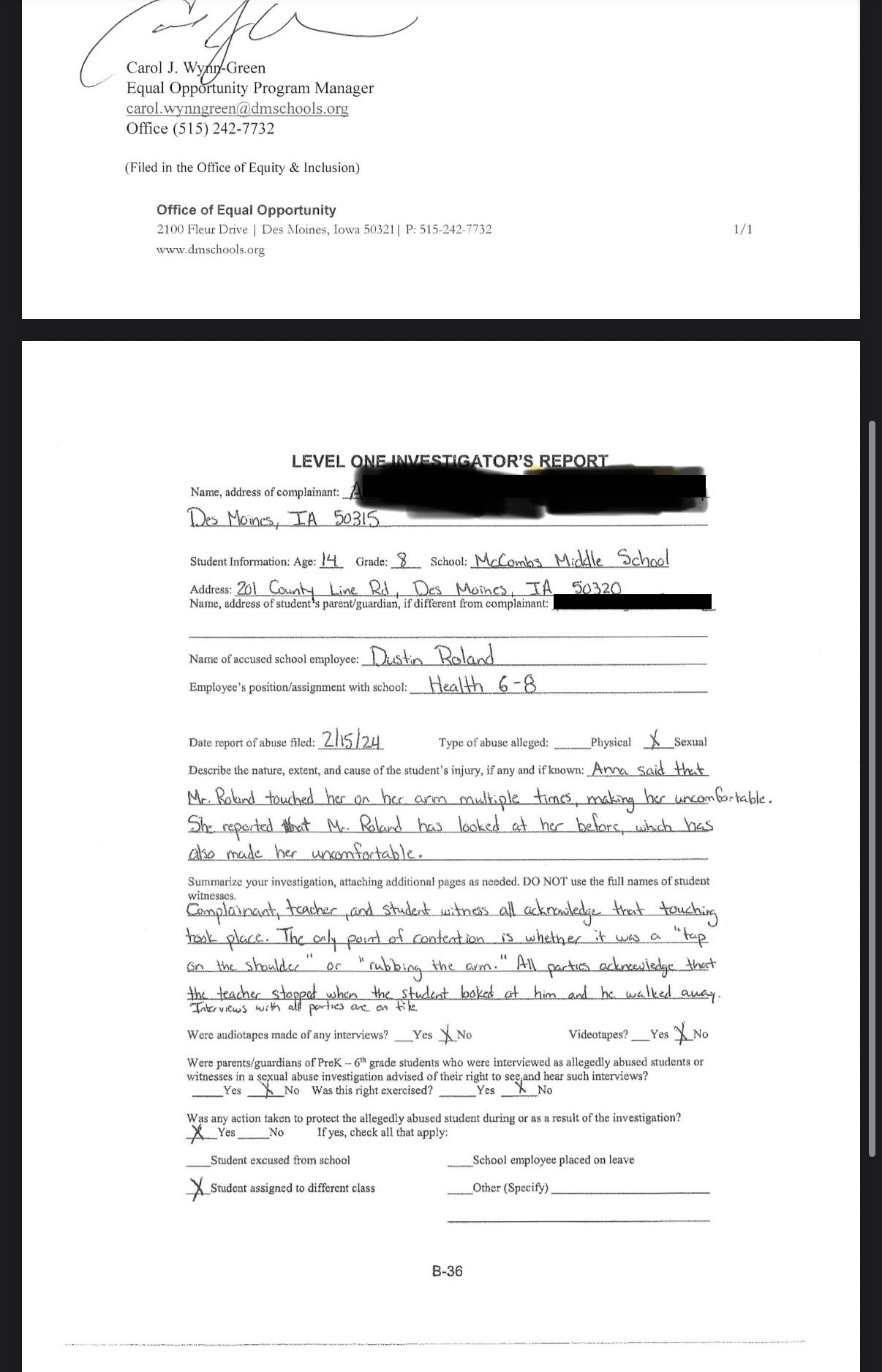
Kathryn obtained a Des Moines Public Schools Level One Investigator's Report concerning Dustin Roland while he was working at McCombs Middle School.
The document identifies the complainant as a 14-year-old eighth-grade student and identifies Roland as the accused school employee.
According to the investigator's written summary, the student, Roland, and a student witness all acknowledged that physical contact occurred.
What they disputed was the nature of that contact. The report describes differing accounts of whether the contact was a tap on the shoulder or rubbing of the student's arm.
The document also records that the student said the interaction made her uncomfortable and that she was moved to a different class.
That document does not, by itself, prove sexual misconduct. It does prove that a complaint was made, investigated, and involved physical contact acknowledged by the people interviewed.
His Own Words
Then Roland addressed middle-school students about the allegations.
Kathryn obtained a recording of Roland discussing the allegations with students in a middle-school classroom.
Watch on the dedicated video page →
In the recording, Roland discusses his career as a teacher, allegations made about him, his work teaching health and reproduction, and the number of students he says he has taught.
He argues that complaints amount to "less than one percent" of the roughly 10,000 students he says he has taught.
He also points to the absence of a finding against him and, in substance, asks students whether he would still be standing in front of them if the allegations were true.
Kathryn's Take
Let's talk about that classroom speech.
Set every individual allegation aside for a moment.
There is still a separate question:
Why were middle-school students being used as the audience for a teacher's personal defense against allegations involving his conduct with students?
These are children sitting in a classroom with an adult who controls the room, gives assignments, evaluates students, and holds institutional authority over them.
They are not investigators. They are not administrators. They are not a jury. And they are not a public-relations audience.
"Less than one percent" is not an answer.
Roland's percentage argument sounds statistical. It is not an evidentiary test.
The relevant question is not what percentage of every student he has ever taught complained about him.
The relevant questions are: What complaints were made? What did the people involved say? What evidence existed? What did investigators find? And what happened afterward?
Dividing the number of complaints by every student someone has ever taught does not make any individual complaint more or less true.
Most students having no complaint tells us almost nothing about what happened to students who did complain.
The number answers a question nobody asked. The issue is not what percentage of Roland's students complained. The issue is what happened to the students who did.
"Would I still be standing here?" is not proof.
Continued employment is not an adjudication of every allegation ever made against an employee.
Pointing to the fact that an institution kept someone employed and then using that employment as proof that the institution must have correctly handled prior complaints is circular.
The fact that Roland was still standing in a classroom tells us that he was still employed.
It does not independently establish what happened in every complaint made before that moment.
"No finding" is not the same thing as "nothing happened."
Administrative investigations have particular policies, definitions, evidentiary standards, available witnesses, documentation, and possible outcomes.
An allegation can result in no disciplinary finding without proving that every underlying event never occurred.
The 2024 DMPS record is a good example of why those distinctions matter.
The document records a complaint, interviews, a student witness, and physical contact that the investigator wrote was acknowledged by the people interviewed.
What that contact meant is a separate question.
Teaching health does not answer allegations about personal conduct.
Roland discusses being a male health teacher and the fact that subjects involving anatomy and reproduction can make students uncomfortable.
Of course health class can be uncomfortable.
But discomfort with curriculum is not the same allegation as discomfort with a teacher's personal behavior toward a student.
One does not answer the other.
The audience is part of the problem.
Adults can deny allegations. Adults can defend themselves. Adults can speak with investigators, administrators, attorneys, journalists, or the public.
But asking children sitting under your authority to absorb your personal defense puts them in a position they should not have been placed in.
Kathryn's view is simple: middle-school students were not the appropriate audience for this speech.
Public Accounts
The comments are allegations. Preserve them that way.
Former students, parents, wrestling participants, and others have posted or provided accounts describing experiences involving Roland.
These screenshots are being preserved because repeated firsthand accounts can identify questions worth investigating.
They are not being presented as automatic proof that every claim in every screenshot is true.
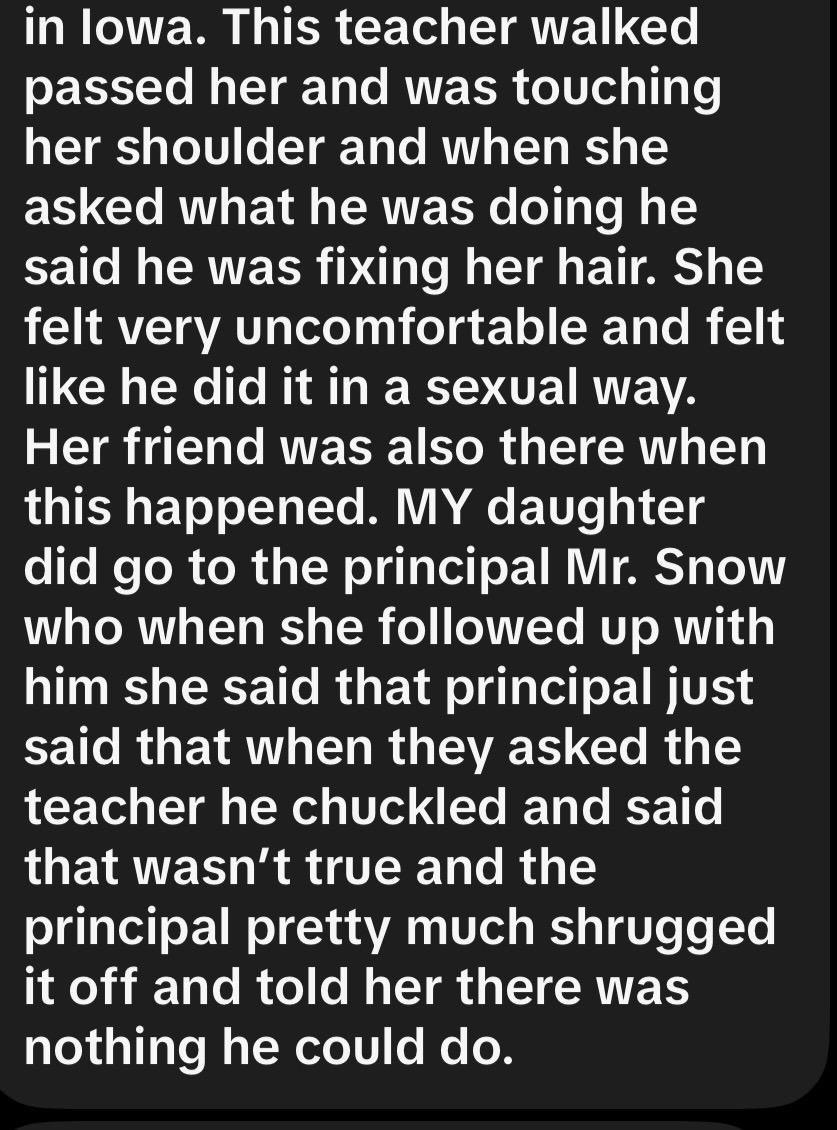
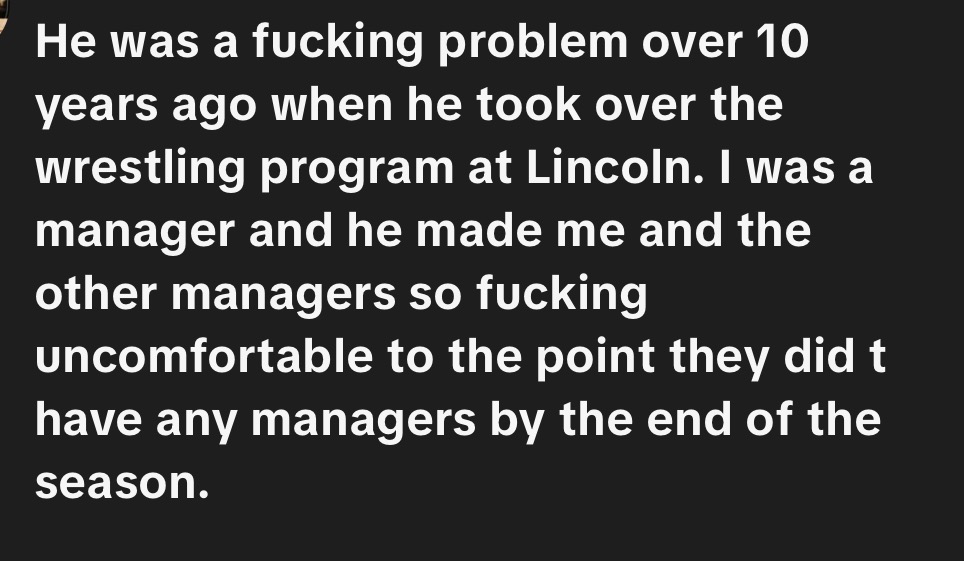
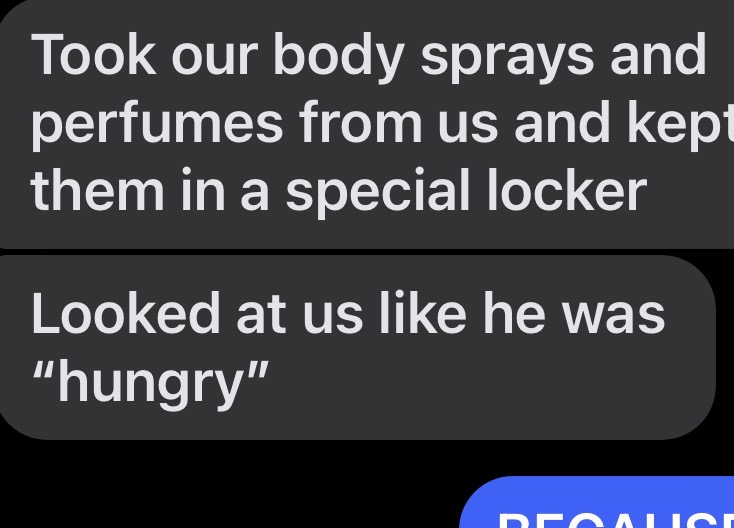

Names and identifying information involving minors will not be published here. Screenshots will be reviewed and anonymized before being added to this page.
Separate Allegation
The ice-bath allegation is part of the broader story.
Kathryn has also reported allegations involving girls in an ice bath after wrestling practice while wearing underwear.
That allegation remains attributed to the people providing the account unless and until additional records independently establish the underlying facts.
It should not be blended with the 2024 McCombs investigation as though they were the same event.
They are separate pieces of a developing timeline involving different years, settings, and sources.
The Bigger Question
How many complaints existed, and what happened to them?
The public-interest question is becoming larger than any single allegation.
How many complaints involving Roland were made over the years? Which schools received them? Which complaints were formally investigated? What did those investigations actually conclude? What records still exist? And what happened after each complaint?
Those are questions documents can answer.
So we're going to keep asking for the documents.
Public Action · September 29
Peaceful protest at McCombs Middle School.
A peaceful public protest is planned regarding concerns about how Des Moines Public Schools has handled complaints involving students.
- Date
- Tuesday, September 29, 2026
- Time
- 2:30 p.m.
- Location
- Public sidewalk across from McCombs Middle School
- Purpose
- Calling on DMPS to protect students and answer questions about how complaints involving school employees have been handled.
This is a peaceful public protest. Stay on public property. Do not interfere with students, dismissal, school operations, or access to the building.
Do not photograph, identify, confront, or involve minors without permission.
Developing
This page will change as the record gets clearer.
Additional documents, direct accounts, media, and institutional responses will be added as they are verified and prepared for publication.
If a record changes the story, the page changes with it.
Show the source. Separate the allegation from the fact. Then keep digging.