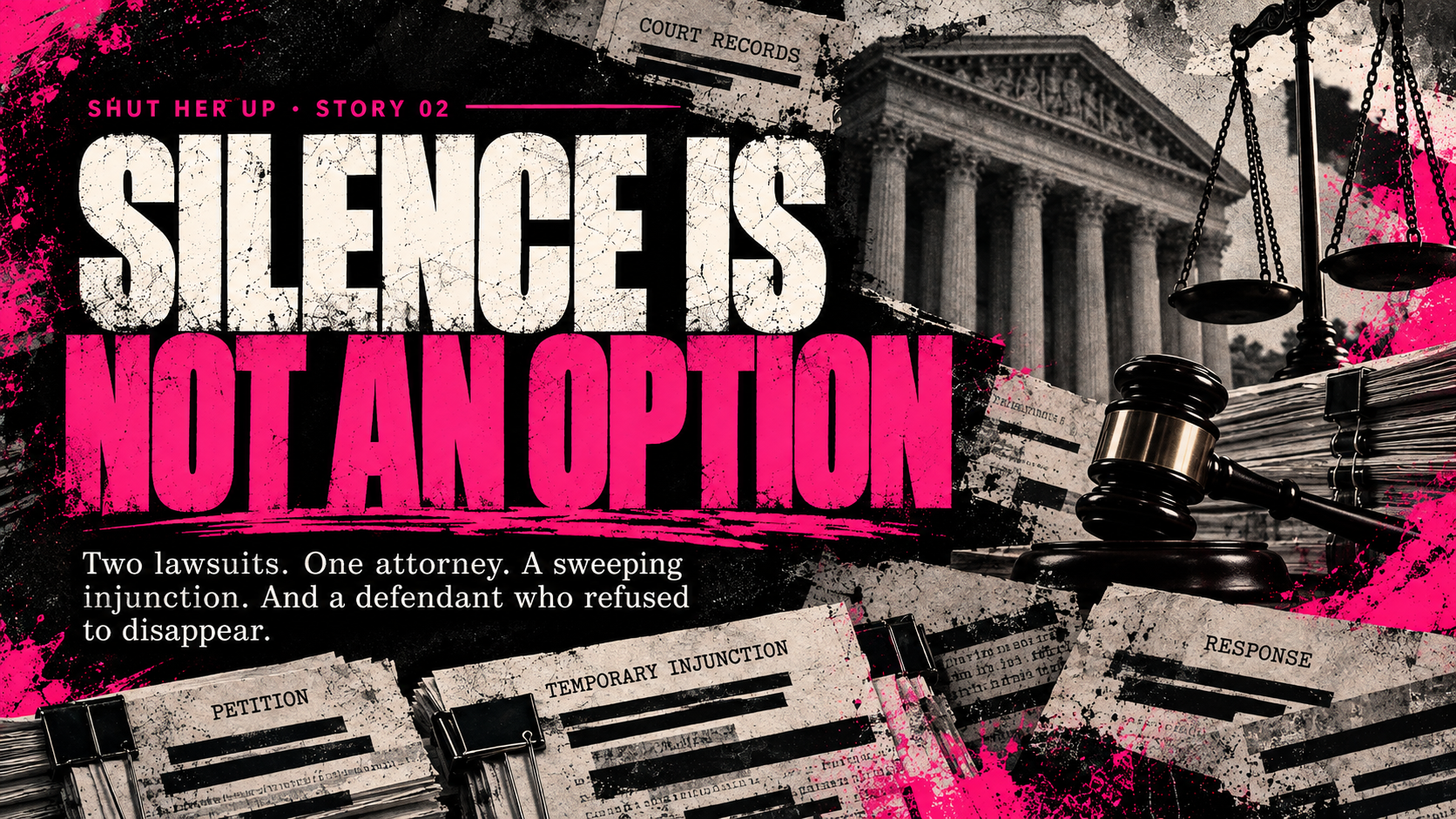
SHUT HER UP · Story 02 · October 17, 2026
Shut Her Up: “Silence Is Not an Option”
Two lawsuits. One attorney. A sweeping temporary injunction. And a defendant who has answered in court.
Katie Byrd was never going to be the easiest person in the room. She can be sharp, profane, relentless, and sometimes her own worst messenger. Her criticism does not arrive in the careful language of an institutional press release. It arrives with anger, receipts, and a refusal to let a question die simply because answering it would make somebody uncomfortable.
None of that proves she is always right. It does not excuse a threat, establish the truth of an accusation, or turn every harsh post into protected advocacy. But it does expose a question that runs through this series: when a person is difficult, do we examine her evidence—or decide her personality is sufficient reason to stop listening?
Byrd's advocacy has drawn attention to student complaints, the response of Des Moines Public Schools, public records, and the words of a school employee addressing allegations about himself in a classroom. The underlying claims remain subject to evidence and dispute. The public interest in asking how a school district handled them does not vanish because the advocate asking is confrontational.
In September, that dispute took a decisive turn. Byrd became the defendant in two civil cases seeking injunctions. The lawsuits have different plaintiffs and distinct factual allegations, but their petitions carry the signature of the same attorney. The overlap deserves examination—especially because one resulted in a court order extending beyond direct contact or specific allegedly unlawful posts to speech about an entire person.
Before Roland, there was another lawsuit.
On September 3, 2026, Mario Sciorrotta filed Sciorrotta v. Byrd, Polk County case CVCV071704. His petition for injunction alleged that Byrd repeatedly posted derogatory material on his Facebook page, used accounts under other names after being blocked, and responded to a customer's favorable comment with a booking photograph. Sciorrotta claimed the associated charge had been dismissed and expunged. Those are assertions in his petition; the filing alone does not independently establish the disposition of the underlying charge or who controlled each social-media account.
In a sworn affidavit, Sciorrotta similarly attributed multiple Facebook identities to Byrd and said he had involved police. The two-page affidavit available in the court-document collection refers to attached messages and posts, but those referenced attachments are not included in that two-page PDF. We cannot evaluate the authorship, completeness, or context of any such exhibits without examining them.
The relief requested was significant but specific: an order preventing Byrd, under any name, from posting on or replying to others on Sciorrotta's Facebook page, contacting him, or directing other people to do so. Whether conduct amounting to unlawful harassment occurred is a question distinct from whether someone's online criticism was embarrassing, vulgar, or unwelcome.
The dates matter. This case began twenty-two days before Dustin Roland filed his own petition on September 25. Until now, the broader public story of the injunction has largely centered on Roland. The earlier lawsuit makes the legal chronology more complicated—and more revealing.
The attorney whose name appears in both cases.
Both petitions were filed through Munro Law Office, P.C. and electronically signed by attorney Kenneth R. Munro. The same lawyer representing two clients against the same defendant is not evidence of improper coordination. People may independently hire the same attorney, and attorneys may properly bring similar claims when they believe facts and law support them.
But the overlap is more than a shared name on letterhead. Both petitions characterize Byrd's activity as harassment under Iowa Code section 708.7. Both invoke Opat v. Ludeking, an Iowa Supreme Court decision addressing civil injunctive relief for stalking and harassment. And both repeat a grave assertion that another person died by suicide following previous posts attributed to Byrd. The filings do not, by repeating the allegation, prove responsibility for that death or a causal relationship. A claim that serious warrants more proof, not less.
The appropriate scrutiny of Munro's work is therefore documentary: what specific acts are attributed to Byrd, what evidence accompanies the pleadings, what legal rule supports the requested relief, and how closely does that relief match the allegedly unlawful conduct? These are questions about a lawyer's public filings and arguments, not an unsupported claim about private motives.
Then came a restriction on the subject itself.
On September 25, Roland filed his petition for an immediate ex parte temporary injunction. He alleged harassment, stalking, threats, statements concerning his whereabouts, and an organized campaign to contact his workplace. Byrd disputes material parts of that account. The allegations require examination as allegations, not judicial findings of each asserted event.
Four days later, on September 29, the court issued a temporary injunction, conditioned on a $500 bond. Its terms prohibited contact and certain location-related conduct. But the order also prohibited Byrd from disseminating, distributing, or posting information regarding Roland under any name, whether online or otherwise, and directed her to remove all references to him that she had placed publicly or online.
That language goes beyond an order prohibiting a particular threat or identified act of stalking. On its face, it reaches future speech about Roland as a subject—including statements that could be accurate, sourced, and wholly unrelated to unlawful contact. The order has legal effect and remains binding unless changed by the court. Its breadth is nevertheless a legitimate subject of constitutional scrutiny.
There is a difference between protecting a person from proven unlawful conduct and protecting that person from being discussed at all. The First Amendment does not immunize true threats, unlawful stalking, or defamation. Yet courts treat prior restraints on publication with exceptional suspicion. In Organization for a Better Austin v. Keefe, the U.S. Supreme Court held that a broad injunction suppressing peaceful distribution of critical literature had not been justified. Iowa's State v. Fratzke also recognized that offensive language does not automatically erase the legitimate purpose of protesting government conduct. These decisions do not predetermine the result in Roland's case; they identify principles against which any restriction must be measured.
She answered with a court filing, not silence.
On October 8, Byrd filed a thirteen-page motion to dissolve, vacate, or modify Roland's temporary injunction. It was not an argument that public advocacy confers immunity from harassment, stalking, or threats. The first page specifically disclaims that position. Byrd instead asked the court to identify unlawful conduct and distinguish it from truthful reporting, criticism, public-record discussion, peaceful protest, and petitioning directed at a public school system.
The motion also disputed factual assertions underlying the petition. Byrd denied physically following Roland or using technology to track him, and maintained that information about his whereabouts came from students, parents, other community members, and public sources. Those are disputed factual positions, not findings. The legal argument goes further: even if particular conduct could lawfully be restricted, why would that justify an order forbidding every public reference to Roland?
Four days later, Kenneth R. Munro filed Roland's response. It opposed Byrd's motion, asserted that the Des Moines and Ankeny school districts had rejected complaints concerning Roland, accused Byrd of continued activity after service of the injunction, and requested a future hearing on making the injunction permanent. The copy reviewed for this article does not attach the school districts' investigative determinations, so the response's account of those findings remains an attorney's assertion in the record.
Thirteen pages. Apparently none of them counted.
The most striking part of Munro's October 12 response is not what it argues about the evidence. It is what it says Byrd didn't argue at all.
In paragraph nine, Munro writes that Byrd's motions “do not address any of the legal aspects of an injunction” and do not contest the allegations in Roland's petition.
That's a remarkable description of a thirteen-page document whose sections are organized around injunction law, the First Amendment, and the facts being disputed. Byrd's filing invokes Iowa Rule of Civil Procedure 1.1509, addresses the standards for temporary injunctive relief, discusses harassment and stalking under Iowa Code sections 708.7 and 708.11, and cites Organization for a Better Austin v. Keefe, Kleman v. Charles City Police Department, NAACP v. Claiborne Hardware Co., State v. Fratzke, and Opat v. Ludeking, among other authorities.
It also disputes the allegations that Byrd followed or technologically tracked Roland. It challenges the characterization of a protest outside a public school and asks that claims involving threats or encouragement of violence be examined in their actual context. Those denials may ultimately succeed or fail. But they are plainly there, in a document filed with the same court.
Apparently, thirteen pages can go missing without ever leaving the docket.
Paragraph eight provides an even more curious contrast. Munro describes Byrd's position as though she claimed an unsubstantiated accusation gave her immunity from harassment and stalking laws, then says she offered no authority for that claim. But Byrd's motion opens by saying it is not asking the court to immunize true threats, stalking, unlawful harassment, violence, or unlawful contact. It challenges the prohibition on otherwise lawful speech. Munro's response rebuts a theory the actual motion expressly disavows.
These aren't obscure differences in legal interpretation. An attorney could reasonably argue that Byrd's authorities are distinguishable, that her account of the facts is unpersuasive, or that narrower restrictions would fail to protect his client. Those would engage the argument she made. Instead, the response characterizes the legal discussion and factual disputes as absent.
And there is a conspicuous omission in the response's own three pages. It invokes the general standards for obtaining an injunction and alleges wrongful conduct, but it does not separately explain why the court's sweeping ban on all information about Roland—including publication that might otherwise be lawful—is constitutionally justified. That breadth is the centerpiece of Byrd's motion. It is not answered merely by asserting that harassment and stalking are unlawful.
Munro also states that Roland intends to pursue contempt proceedings over alleged post-order violations. An intention to file an application is not itself a contempt application, much less a finding that Byrd violated the order. The response asks for a permanent injunction hearing; it does not convert the temporary order into a permanent one.
Why the response describes Byrd's motion this way is not established by the documents. The discrepancy itself is. Readers can compare her October 8 motion with Munro's October 12 response. In a case about what one person may say, the dispute over what that person already wrote is hard to miss.
A second case changes course.
While the Roland injunction drew attention, the earlier lawsuit remained on a separate docket. On October 15, the Sciorrotta v. Byrd docket recorded an answer, affirmative defenses, and a counterclaim for injunctive relief filed by Byrd. That matters. In that case, she is not only opposing the injunction Sciorrotta requested; according to the docket, she has also asked the court for an injunction of her own.
The docket establishes that a counterclaim was filed, not that its allegations have been proven or that the court has granted relief. Until the court-filed answer and counterclaim are independently obtained and read, their precise contents should not be presented as verified from the filing. Nor should the two lawsuits be treated as a single action simply because the plaintiffs retained the same attorney.
There is a procedural clock to watch. Under Iowa Rule of Civil Procedure 1.441(2), a plaintiff ordinarily must serve a reply to a counterclaim within twenty days after service of the answer, subject to motions and court orders that may change the timing. If Byrd's October 15 answer was also served that day, that calculation points to November 4. A docket filing date, by itself, does not establish the service date or an unconditional deadline.
What comes next.
The court scheduled a hearing on Byrd's motion to dissolve the Roland injunction for October 15. The docket records that the injunction hearing took place before Judge Jason Walke. As of the October 16 docket snapshot, the next step in the Roland case will be reflected in further court filings or orders.
The injunction could be dissolved, modified, or maintained through subsequent court action. The legal question remains whether the restrictions are justified by specific conduct and appropriately limited under the First Amendment.
In Roland's case, watch for a written order, another motion, or a scheduling entry. In Sciorrotta's, a reply to the counterclaim or a procedural motion may follow. The next filings will shape what each court is actually being asked to decide.
The voices outside the courthouse.
It would be easy for this series to become a story only about Katie Byrd, Dustin Roland, Mario Sciorrotta, and Kenneth Munro. That would reproduce the very shift in attention that first made this controversy worth examining. The original questions concerned young people, the adults responsible for them, and how a school system responds when concerns are raised.
Byrd is an imperfect advocate. Sometimes she is an abrasive one. That does not make her research correct by definition, and it does not make a critic's objection invalid by definition. It means the work must be judged by its records and the alleged conduct by its evidence. A person's temper is not a substitute for either inquiry.
The court has a duty to consider genuine safety concerns and claimed unlawful conduct. It also operates under constitutional limits when asked to prohibit publication. Those obligations are not enemies. They are the reason that allegations, evidence, and the exact language of an injunction have to be examined separately.
As of the public docket record reviewed through October 16, one case involves a temporary injunction challenged by the defendant. The other now includes a counterclaim seeking an injunction. Those filings move both disputes forward, but a filed allegation remains an allegation, not a finding of fact.
SHUT HER UP will continue obtaining court documents, checking both dockets, and publishing the records that support its reporting. Readers should be able to inspect the sources rather than take anyone's version on faith—including ours.
Because silence does not establish truth. Neither does volume. Evidence does.
And the people who raised questions in the first place still deserve answers.