The White House advance team covered Dubuque’s Solidarity mural ahead of President Donald Trump’s visit, reportedly without authorization from the city or venue operator. That act concealed far more than a colorful backdrop. Every raised fist and several of the letters were deliberately designed to communicate something about disability, mental health, LGBTQ+ inclusion, love, and who belongs in Dubuque. The people who decided to cover it have offered a branding explanation, but no public indication that they weighed what the artwork actually meant. Did they understand the message they were hiding?
What was written on the wall
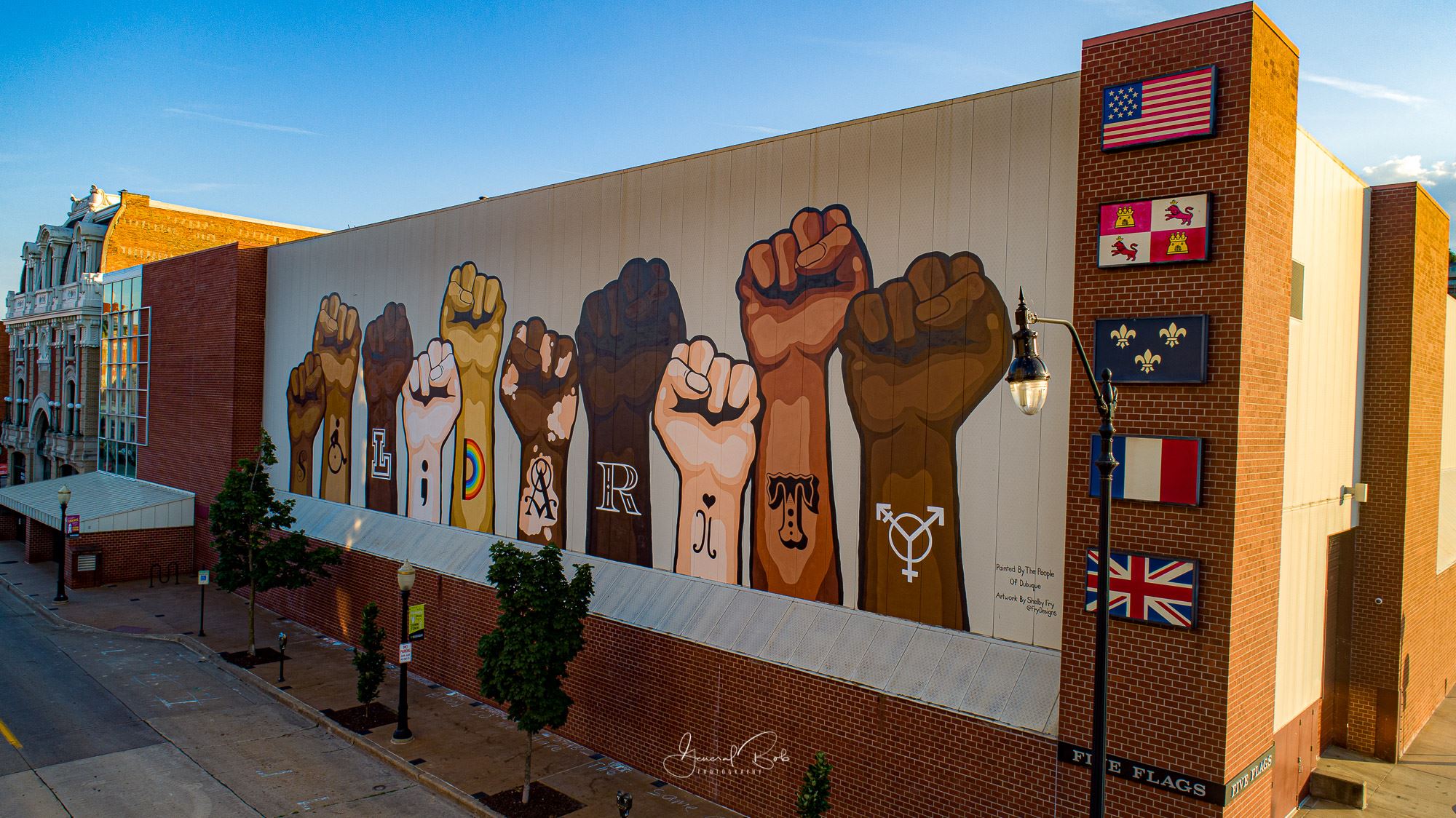
The mural on the east side of Five Flags Civic Center was created in 2020 through a collaboration involving local artist Shelby Fry, Voices Productions, and the City of Dubuque. The city’s official description says more than 75 community volunteers worked over six days to paint the 105-foot-wide, 25-foot-tall piece. Its raised fists, varied skin tones, and lettering are a deliberately public expression of a welcoming community. They are not incidental decoration. The mural was approved for that wall precisely because the people responsible wanted those values visible.
On October 31, KCRG reported that Scott Hallgren, general manager of the venue operator Oak View Group, attributed the decision to cover the mural to the White House advance team. The explanation given was exterior branding and the placement of an American flag. Hallgren said Five Flags Center, Oak View Group, and the City of Dubuque had not authorized anything to be hung on the building’s exterior. The advance team’s stated explanation deserves to be reported accurately. It also deserves scrutiny: a visiting president’s preferred backdrop does not, by itself, confer permission to alter a city’s building.
In Their Own Words: Why Dubuque Painted Solidarity
The city’s own documentary removes any ambiguity about whom the mural was meant to welcome. Explaining the raised fists in different skin tones, the artist describes their purpose as representing everyone “who can live here, who can visit.” She says the project began with the Black Lives Matter movement and grew to embrace disability inclusion, LGBTQ+ rights, and a broader sense of community. Residents in the film describe experiences of discrimination and the hope they felt seeing the mural take shape. The message was intended for Dubuque’s residents and for people arriving from elsewhere.
That last point changes how this incident should be understood. The mural was made in part to welcome people visiting Dubuque; it was then concealed for one of the country’s most prominent visitors. We cannot know whether the people who approved the covering studied the artwork or dismissed it at a glance. But the publicly offered branding rationale gives no sign that they considered the meaning Dubuque had carefully built into its design.
Video: Dubuque Government — Solidarity Mural, Dubuque, Iowa (YouTube). Embedded from the original channel.
The City's official explanation of the mural's symbols makes its message even more specific. The O incorporates a stylized accessibility symbol acknowledging physical and cognitive disabilities. One I is a semicolon associated with suicide prevention and awareness of depression, addiction, and other brain-health concerns; another is dotted with a heart for love and respect. The rainbow D represents the LGBTQ+ community, while the Y combines traditional symbols for male, female, and transgender identities to recognize people across the gender spectrum. Even the L references Dubuque's diverse college programs through its lettering. These were intentional design decisions documented by the city, not meanings invented after the controversy. Covering the mural therefore obscured a series of messages—about accessibility, survival, identity, respect, and welcome—that went well beyond the single word visible from the street.
An American flag is not an answer
The American flag and the mural were never mutually exclusive. Dubuque's artwork was not a rejection of the country; it was a local expression of who should feel welcome within it. If the advance team's goal was simply to display a flag, why was concealing this mural part of the plan? There is no verified evidence that a decision-maker objected to any of the identities or causes represented in the painting. Yet the failure to explain why this particular artwork needed to disappear leaves a serious question about whether its meaning was considered at all.
The distinction between intent and impact matters. We cannot establish whether ideology, indifference, or poor planning drove the decision. We can establish that the advance team covered an artwork meant to communicate belonging, and that venue management reported no authorization for the exterior installation. A decision does not have to be proven deliberately hostile to warrant scrutiny for disregarding a community's chosen symbols.
Local authority matters
There is an important difference between hosting a president and giving an advance team unrestricted control over public property. Large events involve security demands, temporary signage, and careful coordination. None of those ordinary necessities erases the obligation to consult the people who own and manage the venue. If Hallgren’s account is accurate, that obligation was not met here. The public deserves to know who selected the mural for covering, who authorized the physical installation, what instructions were given to contractors, and whether anyone checked the rental agreement before the work began.
Subsequent reporting indicates that the covering was removed after the city objected. That response is significant: it demonstrates that local officials and the operator did not have to accept the alteration simply because a presidential event was involved. Their intervention deserves acknowledgment as an assertion of the community’s authority over its own civic space. The fact that the covering came down, however, does not resolve why it went up without authorization.
Dubuque’s identity is not a disposable backdrop
Dubuque has every right to welcome a presidential visit, to accommodate lawful political events, and to expect its public property to be treated with care. Those rights do not depend on which party occupies the White House. They are basic expectations of any visitor using a community venue. The mural was made by residents who contributed time, physical effort, and a public statement of what they want their city to represent. Disregarding that work is not a trivial staging issue. It is a failure to recognize that the building, the artwork, and the meaning attached to them existed long before the event—and will remain after it.
The White House advance team should explain who chose this wall, what they knew about the mural, and why it was necessary to cover it. Those answers should be tested against the venue agreement and installation communications, not guesses about anyone’s private intentions. Dubuque already explained the mural's meaning, in public, years ago. The people who painted it should not have to explain why a welcome to their neighbors and visitors deserved to remain visible. The people who covered it should explain whether they bothered to understand it.